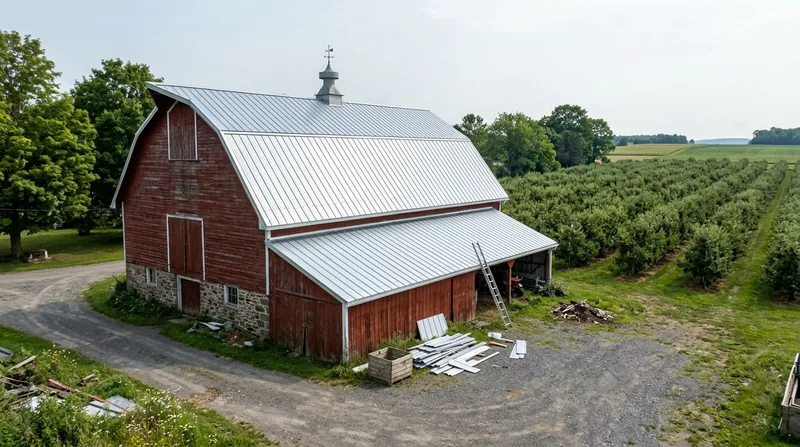




Rochester sits on the Genesee River a few miles south of Lake Ontario, in flat to gently rolling glacial country where farm country meets the city line. That mix drives real demand for Commercial & Agricultural Metal Roofing in Rochester: orchard cold-storage barns out toward Hilton and Spencerport, machine shops and warehouses in Gates and the 14605 corridor, churches with steep slate-look roofs in Corn Hill, and garages and outbuildings behind homes all over Irondequoit and Brighton. Lake-effect snow, ice dams at the eaves, freeze-thaw cycles and wind off the lake punish any roof that isn't built for it. We install and repair exposed-fastener panel, standing seam and through-fastened metal systems on light commercial and agricultural buildings, with insulation and ventilation details sized for Monroe County winters. If you are comparing systems, start with our standing seam metal roofing page for the premium option and work down from there.
Why Agricultural and Commercial Metal Roofing Matters in Rochester's Snow Belt
Rochester regularly sees seasonal snowfall well over six feet, and the failure modes show it. Snow load sits on low-slope barn roofs for months. Ice dams form at eaves and gutters, then meltwater backs up under fasteners. Screw grommets dry out and back out after 15 to 20 winters. On agricultural buildings, condensation dripping from an uninsulated underside rusts purlins and ruins stored equipment or fruit. Metal done right handles all of it; metal done cheap becomes a leak farm.
- Snow load capacity matters most on wide-span barns and shops where trusses were sized for lighter original roofing.
- Ice dam control at eaves and valleys keeps meltwater out of the building envelope during January thaws.
- Condensation control with proper underlayment and insulation protects purlins, hay, equipment and stored goods.
- Fastener integrity on exposed-fastener panels is the number one repair driver on older Monroe County agricultural roofs.
- Wind uplift resistance counts on open farm sites along the lake plain where gusts hit unsheltered gable ends.
Every one of those items is a specification decision made before the first panel goes down, not a patch applied afterward.
Key info: A cold-storage barn outside Hilton and a sheet metal shop in Gates need different panel gauges, different purlin spacing and different ventilation. We spec each building on its own span, snow exposure and interior use, not from a catalog page.
For permit thresholds and inspection requirements on commercial and agricultural re-roofs, verify current rules with the local building department before work starts, since requirements vary by jurisdiction. Monroe County's permitting information is a useful starting reference: Monroe County government.
How We Tackle a Commercial or Barn Roof in Rochester
We start on the ground and work up. The first visit is a walkaround and a look at the underside: purlin condition, truss spacing, existing insulation, and where the water has actually been going. Then we measure spans, check snow exposure against the building's orientation, and put together a panel and fastening plan. No crew goes on a Rochester barn roof without a written scope that names the panel, gauge, fastener type and underlayment.
- Inspection and measurement: we document purlins, decking, flashing and drainage before quoting anything.
- Scope and permit check: we confirm what the local building department requires for your re-roof or new roof.
- Tear-off or retrofit: we remove old roofing or, where code allows and the substrate is sound, install over it with proper separation.
- Underlayment and insulation: we install high-temp underlayment and ventilation or insulation suited to the building's interior use.
- Panel installation: we set panels square to the eave, fasten to spec, and detail ridges, hips, valleys and penetrations.
- Flashing and drainage: we tie in chimneys, vents, skylights and gutters so water leaves the roof the way it should.
- Final walkthrough: we check fasteners, sealant lines and snow retention, then hand over documentation.
That sequence is the same whether we are on a Webster church or a Spencerport apple storage building; only the details change.
Local example: A 1960s pole barn near Honeoye Falls had rusted-through screw heads and water staining on stored hay. We replaced the fasteners, added closure strips and ventilation, and recoated the panels instead of tearing off a structurally sound roof. The owner kept his harvest schedule and skipped a full replacement.
If your building sits inside Rochester city limits, see our Rochester 14605 commercial metal roofing page for neighborhood-specific notes on permits and historic review.
Panel Systems We Install on Monroe County Commercial and Agricultural Buildings
Not every building wants the same roof. A machine shop cares about leak-free performance and low maintenance. A barn cares about cost per square, ventilation and snow shedding. A church or storefront cares about appearance and how the profile reads from the street. We match the system to the building and tell you plainly which trade-offs you are buying.
| Approach | Description | Best for |
|---|---|---|
| Exposed-fastener R-panel | Through-fastened ribbed panels with washered screws, economical and fast to install. | Barns, sheds, garages and utility buildings |
| Standing seam | Concealed-fastener panels with raised seams, fewer penetrations and cleaner lines. | Commercial shops, churches and visible street-facing roofs |
| Insulated metal panel | Factory-foamed panels that combine roofing and insulation in one layer. | Cold storage, heated shops and climate-sensitive storage |
| Retrofit over existing metal | New panels over sound purlins with separation and upgraded fastening. | Aging barns where the structure is still solid |
| Coating and restoration | Cleaning, fastener replacement and elastomeric coating on sound panels. | Rusting but structurally serviceable roofs |
We will tell you when restoration is the right call and when it is throwing money at a roof that needs replacement.
Rusted screw heads and loose fasteners are the most common call we get on farm roofs; that work is covered on our screw replacement and re-fastening page.
Commercial & Agricultural Metal Roofing Cost in Rochester: What to Expect
Pricing on this work is driven by square footage, panel type, roof pitch and access. A simple gable barn with good truck access prices very differently from a flat-roofed commercial building with HVAC units, parapets and a tight downtown lot. Tear-off versus retrofit, insulation spec and the number of penetrations all move the number. We start every project with a free on-site estimate, and we give you a written scope so you can compare bids line for line. Our full pricing overview breaks down what typically drives the total.
- Roof size and pitch determine panel count, labor hours and how much staging the job needs.
- Access and height on silos, tall barns or tight urban lots adds equipment and time.
- Tear-off versus retrofit changes disposal cost and how much deck repair you may face.
- Insulation and ventilation specs add material but pay back in condensation control and energy use.
- Penetrations and flashing around vents, chimneys and skylights are detail-heavy and priced accordingly.
Get two or three estimates and compare scope, not just the bottom line; a low bid that skips underlayment or undersizes fasteners costs more by year ten. You can request yours through our contact page.
Commercial & Agricultural Metal Roofing Near Me: How to Pick a Contractor Near Rochester
This is a trade where the crew matters as much as the material. Ask for proof of licensing and insurance before anyone gets on your roof, and get a certificate of insurance sent directly from the carrier. Ask for references on buildings like yours, not just houses: a contractor who is great on a Pittsford colonial may never have set a panel on a 60-foot barn span. Confirm who pulls the permit and who handles inspection, and check whether your building falls under historic district or HOA design review that restricts panel profile or color.
- Verify the contractor is licensed and insured, and ask for the certificate directly.
- Get at least two or three written estimates with itemized scope.
- Ask for references on commercial or agricultural buildings, not only homes.
- Confirm who pulls the permit and who meets the inspector on site.
- Check historic district or HOA rules before you commit to a panel color or profile.
If a contractor dodges any of those questions, keep calling. Reach us at (585) 298-9938 for a straight conversation about your building.
Commercial & Agricultural Metal Roofing in Rochester: Pricing Guide
| Service | Price | Details |
|---|---|---|
| Roof inspection and written scope | Free estimate | On-site walkaround, purlin check and written scope; building size and access drive the quote |
| Exposed-fastener barn or garage re-roof | Starting at $3.50 per sq ft installed | R-panel, fasteners and underlayment included; tear-off and deck repair priced separately |
| Standing seam commercial roof | Starting at $9 per sq ft installed | Concealed fasteners and formed panels; pitch, height and penetration count move the number |
| Coating and fastener restoration | On estimate | Requires panel condition and rust assessment before a number is given |
| Travel | Included | In Rochester and surrounding Monroe County towns, no separate call-out or mileage fee |
| Estimate | Free | Response within 24h at (585) 298-9938, no obligation to book |
Indicative pricing, the exact cost depends on square footage, finish, and site access. Free personalized estimate within 24h at (585) 298-9938.


